min read
November 18, 2026
2027 Office Pantry Trends: 10 Predictions and Our 2026 Report Card
The biggest 2027 trends are already taking shape: beverages are closing in on snacks, protein is getting a makeover, and every pantry dollar has to prove its value. See how our 2026 predictions played out and what comes next.


In 2027, beverages will overtake snacks as the biggest share of office pantry spend, and that’s just the start. Employees want their snacks and drinks to work harder: more protein, smarter hydration, and something closer to a meal between meetings. At the same time, workplace leaders are under growing pressure to make every pantry dollar count, balancing employee preferences with tighter budgets and a greater focus on measurable value.
Before we look ahead, we’re also holding ourselves accountable. Last year, our 2026 Workplace Trends Report made a set of calls about functional eating, data-driven budgets, and the pantry’s role in bringing people back to the office. Below, we grade how those held up using real data from 750+ Crafty-powered pantries, then share our predictions for 2027, from the safest bets to our boldest calls.
Key Takeaways
- Our 2026 calls mostly landed: Functional eating, protein, and data-driven budgets all played out, while a few trends are still taking shape.
- Drinks take the lead: Beverages grew from 28% of pantry spend in 2025 to 34% in Q3 2026, and we expect them to claim the top spot in 2027.
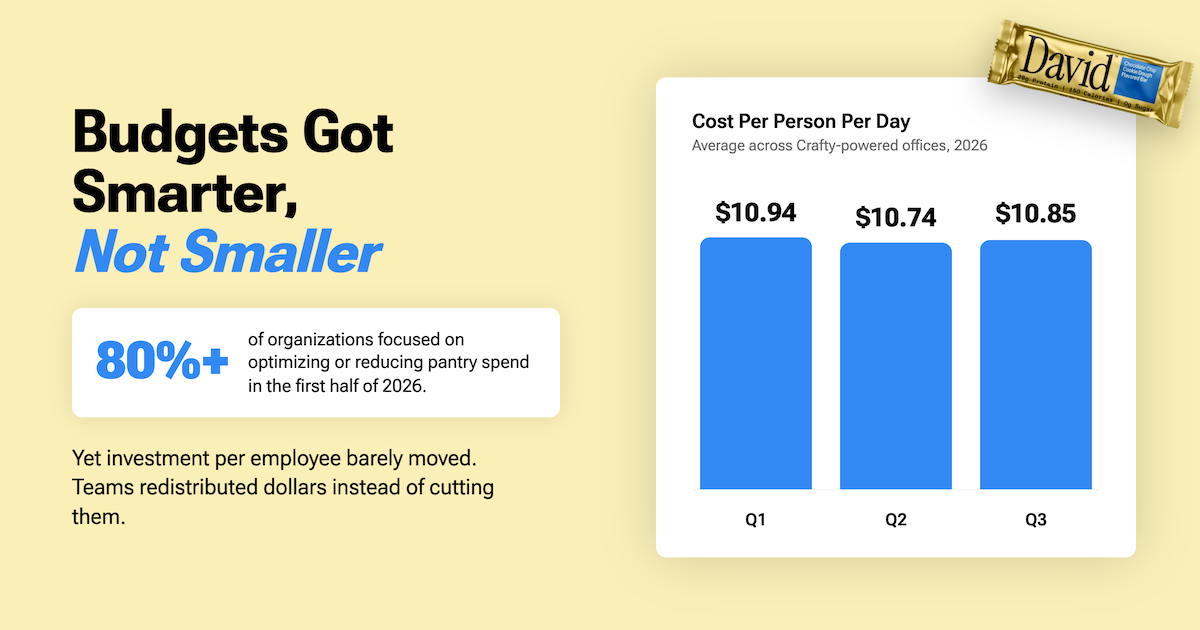
- Budgets get smarter: More than 80% of organizations focused on optimizing or reducing spend, yet per-person investment held steady at $10.85 a day.
- The pantry gets a scorecard: Workplace leaders will measure success by how well their investment performs, not just how much they spend.

2026 Report Card: How Our Office Pantry Predictions Held Up
Seven of our 2026 calls landed, two partly played out, and one is still developing. Here’s the scorecard.
1. Functional Fuel Goes Mainstream: Called It
We said employees would expect more from every product on the shelf, and they did. fairlife Core Power leads sports and protein drinks, functional hydration dominated the distributor trade shows, and brands are now reaching beyond energy with ingredients designed for focus and calm.
2. Protein Becomes a Priority: Called It
Bars were the top subcategory by spend in 2025, and they remain the second most popular subcategory by units in Q3 2026, with Barebells Cookies & Cream as the top seller. Nearly half of US adults (48%) now say they want more protein!
3. Healthier Perishables Grow: Called It
We flagged growth in produce and deli. In 2026, Fresh & Frozen spend climbed sharply early in the year and stayed elevated, while Deli & Prepared Foods entered the top 10 subcategories for the first time.
4. Amenities Drive Attendance: Called It
September 2026 office visits hit their highest September level since 2019, and companies like Fidelity and TikTok moved to full-time office schedules. As more people came in, pantry spend followed.
5. Data Powers Precision: Called It
We predicted the advantage would go to companies using intelligent platforms. This year, Crafty launched the Pantry Intelligence Index, introduced cost per person per day as a headline benchmark, and rolled out Office Digest to bring tailored, AI-powered recommendations to every office each month.
6. Spend Gets Redistributed: Called It
More than 80% of organizations focused on optimizing or reducing pantry spend in the first half of 2026. Even so, investment per employee stayed remarkably steady, from $10.94 in Q1 to $10.74 in Q2 and $10.85 in Q3.
7. Drinks Gain on Snacks: Bigger Than Expected
We knew beverages were doing more, but not how fast they’d grow. Drinks went from 28% of pantry spend in 2025 to 34% in Q3 2026, essentially tying Snacks & Pantry at 34.1%.
8. Spend Peaks in April, July, and October: Partly
April and July held up, with July office visits climbing above June. But 2026 also brought a strong March and September, giving the year two clear peaks in spring and fall. We’ll check in January once Q4 data is in.
9. Sugar Reduction and Fiber Take Off: Still Developing
Sugar reduction is already showing up in the pantry, especially in drinks. Diet Coke is the top-selling soda, and Hint Watermelon leads flavored and infused water. Employees are keeping the drinks they love while cutting back on sugar.
Fiber is moving more slowly. We expect it to show up first in popcorn, produce, breakfast, and sodas, and HIPPEAS Chickpea Puffs overtaking SkinnyPop is an early sign. Diet Coke isn’t going anywhere, but growth in better-for-you sodas like Olipop would be the next proof point. We’re carrying fiber into 2027.
10. AI Hubs Drive the Highest Spend: Partly
AI is fueling office demand across major hubs. In San Francisco, Q3 leasing rose roughly 77% year over year, led by AI and tech companies. Across Crafty’s network, Los Angeles and Dallas-Austin are among our fastest-growing markets, and both are home to metros Brookings ranks among the top fueling the AI economy.
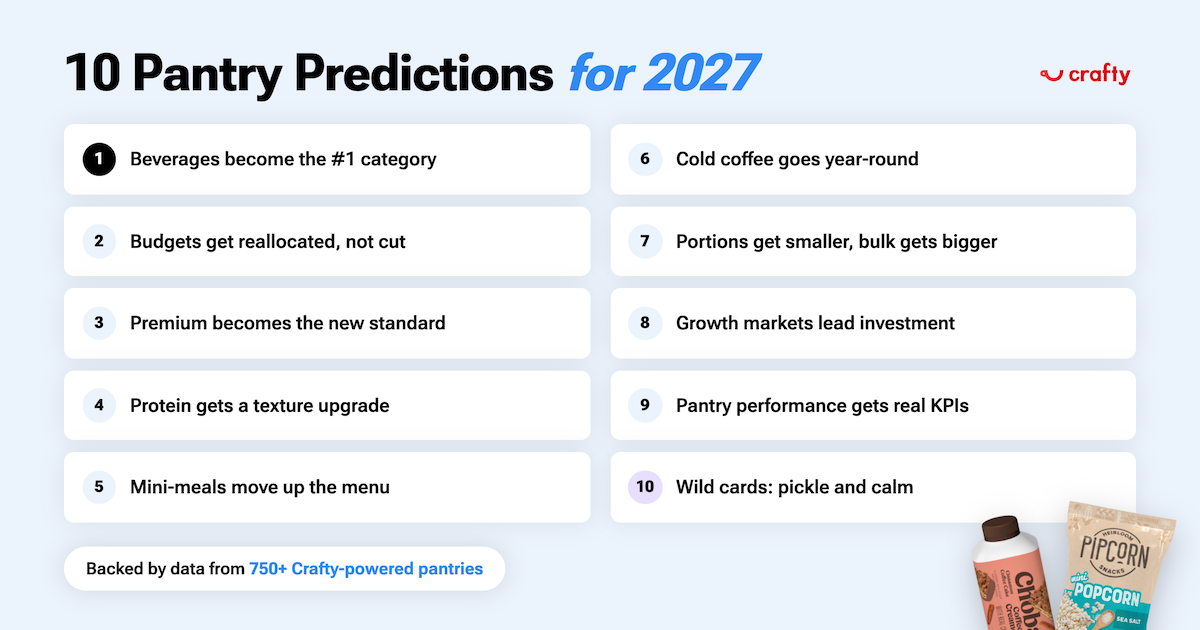
10 Office Pantry Trends to Watch in 2027
Our predictions start with the trends the data already supports and build to the calls we’re still watching closely.
1. Beverages Become the #1 Pantry Category
Drinks gained six points of pantry spend in a single year, and in Q3 2026 they trailed snacks by just 0.1 points. We expect beverages to officially take the lead in 2027. They’re no longer just something to wash down a snack: 68% of consumers sometimes reach for a drink instead of food, and protein shakes, coconut water, and functional drinks are filling that role in the office.
2. Budgets Shift Toward What Employees Use
As employers look to get more from their pantry budgets, every dollar has to earn its place. The 2026 data shows employers aren’t pulling back on their investment. Instead, we expect more teams to trim slow movers, convert high-volume items to bulk, and redirect dollars toward what employees actually use, keeping per-person investment steady while getting more out of it.
3. Premium Becomes the New Standard
The average office now invests $10.85 per person per day, which puts the typical pantry in our Premium tier. Products once considered premium extras are now everyday best sellers: Core Power leads sports and protein drinks, La Colombe leads cold brew, and GT’s leads kombucha. In 2027, we expect even more of these upgraded options to become pantry staples.
4. Protein Gets a Texture Upgrade
Protein bars aren’t going anywhere, but they’re getting more interesting. Quest’s new Crispy and Stacks bars bring more crunch and layers to compete with indulgent favorites like Barebells. Protein is also showing up in new formats, from protein balls to protein-packed PB&J sandwiches. We’re watching to see whether a crispy bar cracks the top five in 2027.
5. Mini-Meals Move Up the Menu
The line between snack and lunch keeps blurring. Deli & Prepared Foods entered the top 10 in Q3, and dried fruit, nuts, and trail mix moved ahead of produce. Single-serve hummus, grab-and-go breakfasts, and protein-packed sandwiches give employees something more filling between meetings. We expect Deli & Prepared Foods to keep climbing in 2027.
6. Cold Coffee Goes Year-Round
Coffee spend climbs as temperatures rise, but iced coffee and cold brew aren’t disappearing when summer ends. Cold brew has become a year-round staple, and we expect cold coffee to hold strong through the winter months in 2027, especially in offices that offer it on tap.
7. Portions Get Smaller and Bulk Gets Bigger
Serving formats are splitting in two directions. As GLP-1 use grows, 48% of users say they’re buying more portion-controlled foods, and brands like Catalina Crunch are introducing smaller single-serve sizes. At the same time, more offices are moving cold coffee, sparkling water, nuts, and cereal to kegs and bulk formats to reduce waste and cost per serving. Expect the best pantries to use both.
8. Growth Markets Lead Pantry Investment
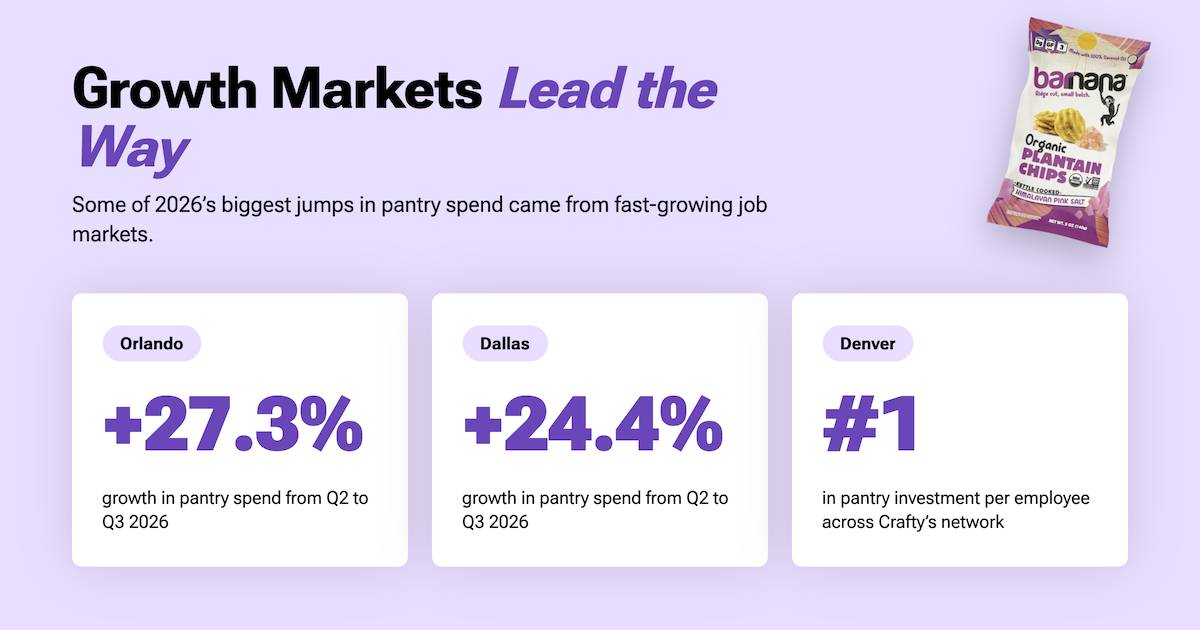
Some of the biggest jumps in 2026 came from fast-growing job markets. Orlando increased pantry spend 27.3% from Q2 to Q3, Dallas grew 24.4%, and Denver now leads the network in investment per employee. In 2027, we expect these markets to keep pushing pantry investment higher as employers compete for local talent.
9. Pantry Performance Gets Real KPIs
For years, pantry success came down to a few broad questions. Did we stay on budget? Were the shelves stocked? Did employees seem happy? In 2027, we expect workplace leaders to measure performance more precisely, comparing what employees request with what they actually eat, tracking fast and slow movers, and connecting investment to the experience they set out to create. Spend will still matter, but it won’t be the only measure of success.
10. Wild Cards: Pickle and Calm
Our boldest calls are two early signals from the show floor. Pickle has moved from novelty to mainstream, with Quest launching a dill pickle flavor and brands like Poshi bringing tangy, veggie-forward snacks to the pantry. Meanwhile, more drinks are being built for focus and calm rather than energy, with ingredients like L-theanine, GABA, ashwagandha, and magnesium. Neither shows up in our top-seller data yet, but we think 2027 is the year one of them breaks through.
How to Plan Your Office Pantry for 2027
You don’t need to chase every trend. Start with what your employees already love, then make a few intentional changes:
- Rebalance toward beverages: Review how your budget splits between snacks and drinks, and make room for functional options like coconut water, electrolyte drinks, and protein shakes.
- Refresh your protein shelf: Keep the bars employees love, then test new flavors, textures, and formats.
- Add a few mini-meals: Single-serve hummus, deli items, and grab-and-go breakfasts give employees more filling options without a full catering budget.
- Rethink how you serve: Use single-serve packs where portion control matters and bulk formats or kegs for high-volume items.
- Measure what’s working: Compare your cost per person per day with your industry and market in the Pantry Intelligence Index, then use consumption data and employee feedback to decide what stays, what goes, and what to test next.
Office Pantry Trends FAQs
What are the biggest office pantry trends for 2027?
Beverages overtaking snacks, functional hydration, new protein formats, mini-meals, and a mix of smaller portions and bulk formats are leading the way. Workplace leaders are also shifting how they measure success, focusing on how well their pantry investment performs rather than spend alone.
How much do companies spend on office pantries per employee?
In Q3 2026, the average office invested $10.85 per person per day, or $15,551 per month, based on Crafty data across the US and Canada. Investment varies widely by industry and market, so benchmarking against peers gives you the clearest picture.
How should I adjust my office pantry budget for 2027?
Start with your cost per person pfer day, compare it with your industry benchmark, and use consumption data to find opportunities to reallocate. Shifting spend from slow movers to what employees actually use often delivers a better experience without increasing your budget.
Get Ahead of 2027
The pantries that win in 2027 won’t be the ones that spend the most. They’ll be the ones that know exactly what their employees value and invest accordingly. With real-time benchmarks, monthly performance insights, and a team that scouts what’s next, Crafty helps you build a pantry that keeps up with your people.
See how your pantry compares in the Pantry Intelligence Index, or talk to an expert to start planning your 2027 program. Plus, stay tuned for our 2027 Trends Report!
Related Resource
Blog
2027 Office Pantry Trends: 10 Predictions and Our 2026 Report Card
November 18, 2026
Blog
Data Bites: The Most Popular Holiday Office Snacks
November 18, 2026

Blog
Best Colorado Snack Brands to Stock in Your Office Pantry
November 17, 2026

News
Crafty Hires Workplace Refreshment Veteran Dion Santo as Bay Area General Manager
November 12, 2026

Blog
Best Texas Snack and Coffee Brands to Stock in Your Office Pantry
November 11, 2026

Blog
Snacky Hour Episode 3 Recap: Poshi Veggie Snacks Review
November 9, 2026
Blog
High-Protein Recipes for Work: Easy Snack Hacks from the Office Pantry
November 6, 2026

Blog
5 Signs You’ve Outgrown Your Corporate Food Service Provider
November 6, 2026

Blog
Office Snack Scoop Episode 2 Takeaways: Layered Comfort, Bold and Briny, and Functional Flashbacks
November 5, 2026