min read
September 28, 2026
Tap an Expert: How to Build an Office Pantry Lineup Across Every Office
We tapped Hector Avelar, Strategic Account Director at Crafty, to break down how to build a pantry at any budget.


Key Takeaways
- Build your pantry lineup from the ground up: choose equipment first, cover the four core categories, then put a price on what one employee consumes each day.
- For multi-office companies, set one cost per person per day company-wide and let each office's headcount determine how much variety it can support.
- Break your annual budget into order-level spend targets so every location stays on track without constant oversight.
Why Enterprise Office Pantries Need a Different Approach
Running a pantry across multiple offices comes with a built-in challenge: every location is different. Headcount, attendance, space, and employee preferences all shape what works. A headquarters with hundreds of employees coming in four days a week shouldn't have the same pantry as a smaller regional office on a hybrid schedule.
But leadership still needs consistency. Without a clear framework, multi-office programs can quickly drift. One office overspends while another runs out of staples. Product mixes look completely different. And no one has a clear view of what the company is actually investing per employee.
That matters even more as workplace budgets face more scrutiny. The pantry is one of the benefits employees interact with every day, making it a visible part of the office experience and the competition for talent. The goal is to know where every dollar is going and make sure it's having an impact.
The strongest enterprise pantry programs balance both sides: consistency across the company and flexibility at the office level. We sat down with Hector Avelar, Strategic Account Director at Crafty, to break down how he builds that balance into an office pantry lineup from the ground up.
How Do You Approach Building an Office Pantry Lineup for Enterprise Clients?
It always starts with the experience, not the number. A lot of companies pick a budget first and try to fit a pantry around it. That's how you end up with empty shelves in one office and excess inventory in another.
With my enterprise clients, we work in reverse. We figure out what employees should have access to each day, put a cost behind it, and then build the budget to deliver it. For a company with offices in several markets, that bottom-up approach is what keeps the program consistent. Everyone works from the same framework, even if each office looks a little different.
Where Do You Start When Building a Pantry Lineup?
Equipment. It's the physical foundation of the pantry, and what you choose determines which products you'll need to support it.
If a client chooses a bean-to-cup espresso machine, for example, they'll need whole-bean coffee, possibly multiple roasts, milk and dairy-free options, and sweeteners and syrups. They won't need single-serve coffee at all. Every setup comes with its own product requirements and costs, whether it's office coffee machines, a kegerator for cold brew, or a flavored water machine.
For national pantry programs, we map equipment out location by location, since available space and how people use each pantry can vary. Getting those decisions right upfront gives you a much more accurate foundation before you choose a single product.
What Should Every Office Pantry Lineup Include?
Every lineup starts with four core categories, regardless of budget:
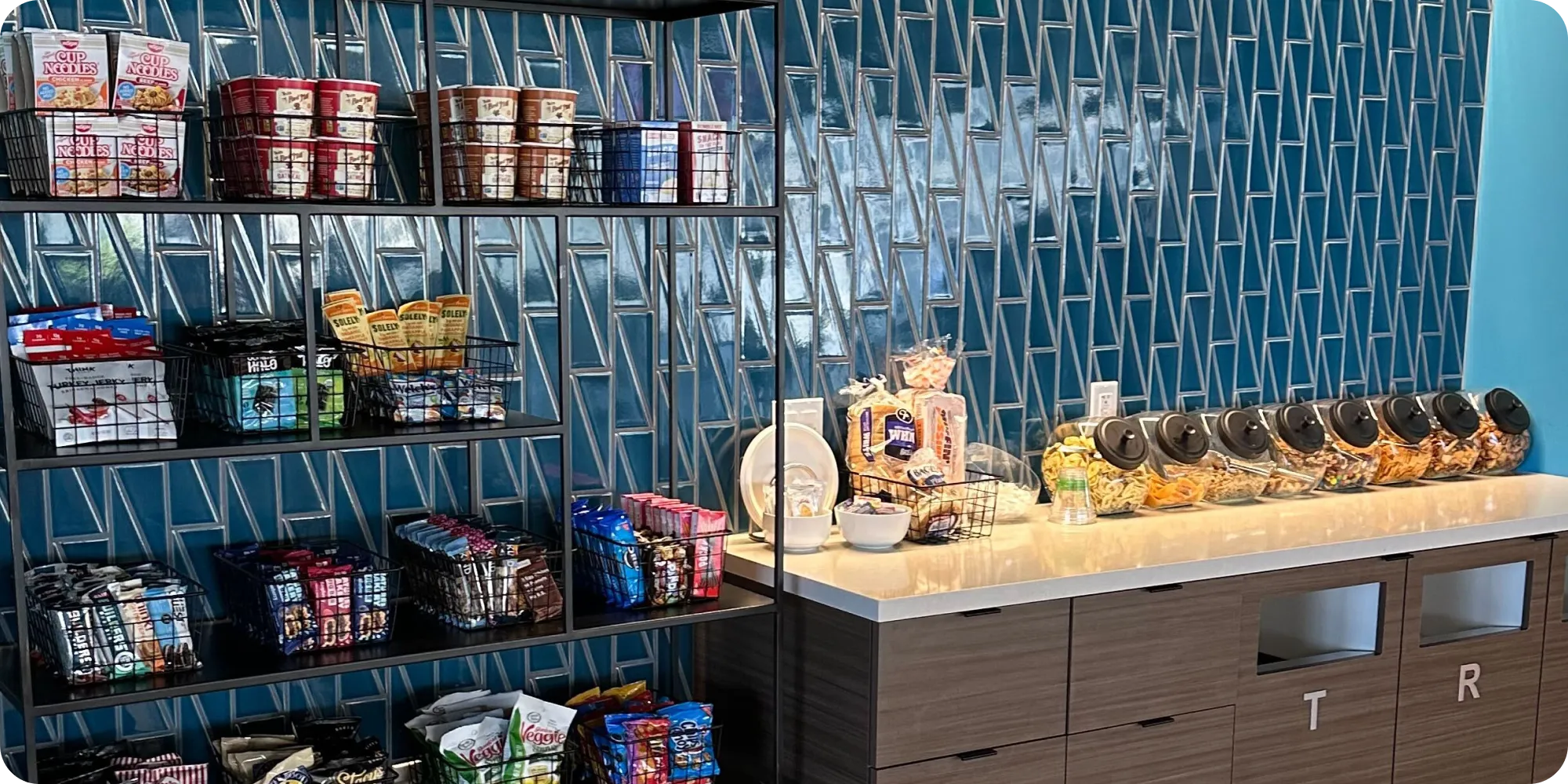
- Breakfast: Coffee, milk, creamers, sweeteners, juice, bread, breakfast foods, protein drinks, and bars
- Lunch Add-Ons: Frozen foods, deli products, canned products, produce, sodas and water varieties, and condiments
- Afternoon Snacks: Sweets and candy, nuts and trail mix, jerky, protein bars, chips, energy drinks, kombucha, and tea
- Supplies: Plates, utensils, cups, napkins, serveware, and cleaning products
Together, these cover what employees rely on throughout the day. Your budget determines how you build within them, from the quality of the products to how much variety you can offer.
How Do You Decide What to Prioritize in the Lineup?
Consumption is the biggest factor. More products, more variety, and fuller shelves all increase spend, so I ask clients to decide what they want their budget to prioritize:
- Quantity: More options and fuller shelves throughout the day
- Quality: Higher-end products with more intentional limits on quantity and variety
- Everything: Premium products, broad variety, and full shelves, with the budget to support it
From there, we layer in employee preferences, dietary needs, and brand values. Some clients want more better-for-you options. Others want to feature local favorites in each market, which is a great way to give every office its own personality within one national program.
How Do You Calculate Cost per Person per Day?
Once we've mapped out a typical day in the pantry, we put a price behind it by adding up the average cost of what one employee might grab. Coffee ($1), cereal ($1), chips ($2), a soda ($1), and a bar ($2) come to $7 per person per day. Higher consumption and more premium products push that number up.
That number places a client in one of three cost per employee tiers: Essential at $5–$7.50 per person per day, Elevated at $7.50–$10, and Premium at $10 or more.
For context, the average Crafty-powered pantry spends $10.85 per employee per day, and that number varies widely by industry. That's why I have clients benchmark against the companies competing for the same talent in the Pantry Intelligence Index.
How Do You Keep the Pantry Consistent Across Multiple Offices?
This is the biggest question I get from enterprise clients. The answer is to set one cost per person per day company-wide, then let each office's headcount shape its lineup.
Your tier sets the quality of the experience, while headcount determines how much category and flavor variety you can build around it. So a large headquarters and a smaller regional office can deliver the same level of investment per employee, even though the larger office carries a broader lineup.
That gives the company one consistent standard across every location, while each office still gets a pantry that fits its team. Pairing a national framework with local customization is what makes enterprise pantry programs work.
How Much Variety Can Each Office Support?
Variety scales with the budget. An office spending under $5,000 a month might carry around five bar varieties, and that number grows as your monthly budget increases. The same pattern holds across nearly every subcategory, from coffee to sweets.
Once you know your range, prioritize the categories your employees care about most. If a team values protein bars over jerky, offer more bar varieties and fewer jerky options. Just keep an eye on price per unit so added variety stays aligned with your budget.
How Do You Keep Every Office on Budget?
We build it up, then break it down. First, multiply your cost per person per day by your average headcount and working days to get your total budget. Then divide that budget by 12 months and by your delivery days per month to get an order spend target.
Inside the Crafty Platform, that per-order target is shared with both the client's team and ours, so every order lines up with monthly and annual goals. For multi-office clients, that's what keeps each location on track without someone at headquarters checking every order, while leadership can still track spend in real time across every office. For the full walkthrough, see our step-by-step guide to calculating your office pantry budget.
What Do You Do When a Product Disappears Too Fast?
I had a national financial services company whose premium protein drinks were disappearing almost as quickly as we stocked them. Instead of removing them, we changed where they were placed and limited restocks to certain times of day. Employees kept the products they loved, and consumption stayed in check.
Small adjustments like that, along with product swaps and cutting slow movers, are how we help clients solve the Perk Paradox without cutting the perks employees value.
What's Your Best Advice for Workplace Leaders Building a Pantry Lineup?
Don't pluck a number out of thin air. Start with the experience you want employees to have, understand what it costs to deliver it, and build from there. When your lineup is built from real consumption, you can invest in what employees value, cut what they don't, and adapt as each office changes.
Want the full framework? Get Crafty's 2026 Ultimate Guide to Office Pantry Budgeting to see how to benchmark, build, optimize, and forecast your pantry budget across every location.
FAQ
What is a good cost per person per day for an office pantry?
The average Crafty-powered pantry spends $10.85 per employee per day nationally, but the right number for your office depends on your industry, market, and the companies you compete with for talent. Benchmark your spend against peers in Crafty's Pantry Intelligence Index.
How many product varieties should an office pantry offer?
It depends on your monthly budget and headcount, since larger budgets support more varieties in every subcategory. See exactly how variety scales at each budget level in Crafty's 2026 Ultimate Guide to Office Pantry Budgeting, then prioritize the categories your employees value most.
How do multi-office companies manage one pantry budget?
Set one cost per person per day across the company, let each office's headcount determine its variety, and break budgets into order-level spend targets so every location stays on track.
Related Resource

Blog
Office Pantry Services in Texas: How Crafty Is Growing Across Dallas, Austin & Houston
October 15, 2026

Blog
What Makes Fruit “Office-Ready”? From Farm Selection to Delivery Standards
October 15, 2026
Blog
The Procurement Guide to Evaluating Office Pantry Providers
October 14, 2026

Blog
Equipment Guide: Sparkling Water Machines for the Office
October 14, 2026

Blog
Best Organic Office Snacks: What to Stock and How to Read the Labels
October 13, 2026

Blog
Data Bites: Office Pantry Spend Per Employee by Industry in 2026
October 13, 2026
Blog
Inside Office Digest: How Crafty Measures Office Pantry Program Performance
October 12, 2026
Blog
Equipment Guide: Cold Water Machines for the Office
October 8, 2026
Blog
How to Reduce Office Pantry Costs with 7 Optimization Tips
October 8, 2026
Blog
November Holidays for Work: Snack Celebrations for Your Breakroom
October 8, 2026