min read
December 16, 2025
How Real-Time Data Creates Smarter, More Strategic Pantries
Chris Ritter, Crafty’s COO, explains why delayed data isn't just an inconvenience; it's a liability.

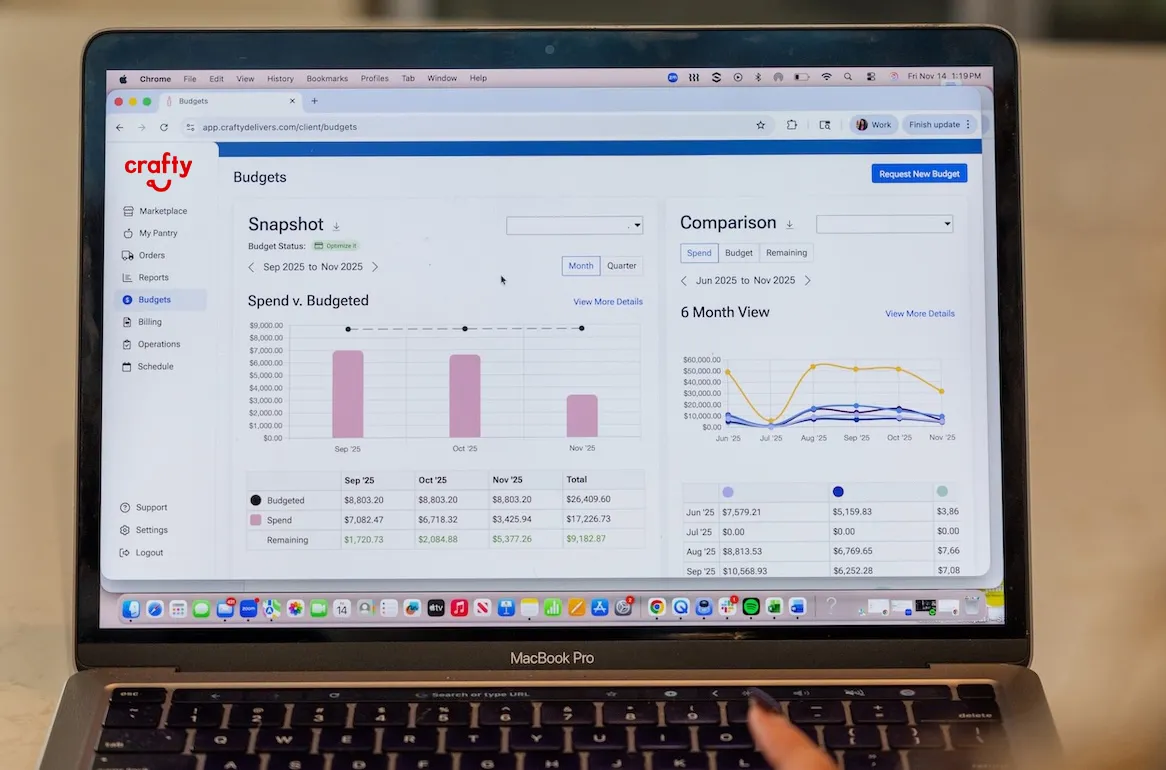
In today's ever-evolving economic landscape, every minute counts. Executives are under constant pressure to make informed decisions swiftly, especially when it comes to driving more operational efficiencies without compromising growth.
Financial clarity and operational flexibility become essential during these times. This is especially true in areas like the workplace pantry, where the line between employee experience and cost control is often thin.
But here’s the reality: time is money. If your team is digging around for basic information, whether it’s spend by location, open support issues, or product usage, you’re losing both. Delays in visibility lead to delays in action. Those gaps don’t just slow your team down; they inflate your operating costs, erode trust, and create a reactive culture where teams are always playing catch-up.
I want to dive into the key insights from the Pantry Optimization Playbook to show how real-time insights can transform your pantry from a passive perk into a high-performing business asset. You’ll also hear from a workplace leader who’s made that shift and seen firsthand what’s possible when teams stop chasing clarity and start leading with it.
The Cost of Chasing Data
If your team is still spending time pulling reports, consolidating spreadsheets, or chasing invoices, you're not managing a strategic program; you're stuck in survival mode. That time is pulling your most capable people away from the work that moves the needle. Every delay in data is a delay in action, resulting in a delay in impact. In a high-performing organization, that’s unacceptable.
Here’s what’s at stake:
- Team capacity is eaten up by reactive work
- Visibility gaps drive avoidable spend and missed opportunities
- Operating costs rise because support becomes manual and messy
Time is your most valuable and most expensive resource. As leaders, we need to spend more time analyzing and acting and less time chasing and gathering. We want to enable our teams to have what they need quickly to course-correct in real-time, optimize for efficiency, and forecast accurately. When data is delayed or nonexistent, you miss the window to act. And when you miss the window, you lose control of budgets, performance, and ultimately, outcomes.
Why Speed = ROI
In today’s workplace, speed is the engine behind operational ROI. Real-time visibility gives teams the power to move and shift from being reactive to being proactive.
As a COO, I don’t just need to know what we spent; I need to understand where that spending is headed and why it’s worth continuing. That means I need the ability to instantly break down spend by office, category, and even product type without waiting on a custom report or pulling data from five places. If pantry costs spike at one location, I want to see it now and act, not months later when there is nothing we can do about it.
More importantly, I want to empower my operations teams to take ownership of their budgets with the same level of clarity. The tools we use should promote accountable, informed decision-making that is built into the workflow, not managed through oversight. It shouldn't fall on finance to chase down answers or enforce spend guardrails. Budget visibility and reporting should do that work for us, making it easy for every stakeholder to act responsibly in real time.
That’s why there are a few core reports I expect both operations and finance teams to have at their fingertips:
- Spend vs. Budget: Tracks spend in real time against allocated budget so I can ensure we’re pacing correctly, avoiding last-minute overspend, and staying aligned with financial targets.
- Subcategory Spend: Breaks down spend across detailed line items like snacks, beverages, and wellness. This helps support financial planning, enables clean tax reporting, and can even help our HR/People teams take advantage of healthcare savings opportunities.
- Account Spend by Location: Gives a clear, month-over-month view of how each office is performing. If one location spikes, I want to know immediately so we can dig into what changed and whether it needs to be scaled, adjusted, or replicated elsewhere.
Real-time reporting gives you leverage. It lets you identify problems before they escalate, act on opportunities before they disappear, and continuously optimize without waiting for a review. When you have that kind of visibility, you operate smarter, which drives ROI.
Lessons from the Field
I’ve seen it too many times: a workplace team thinks they’re saving money by piecing together programs with multiple vendors, using corporate cards across offices, or working with providers that have lower prices on the surface but outdated systems, so you don't know what's going on once you get started. I see the appeal, but in my experience, what looks like savings on paper often creates massive overhead for both the operations and finance teams behind the scenes.
That’s exactly what the team at a leading consumer food delivery platform was dealing with. Credit card charges were hitting across five offices with no centralized system. Invoices showed up months late and couldn’t be matched to actual orders. Reporting wasn’t just slow, it was incomplete, manual, and in their words, "a nightmare."
When that happens, it doesn’t just slow down reconciliation. It puts the entire business at risk. You can’t forecast. You can’t validate budget performance. You can’t explain variances to leadership without spending hours manually pulling and scrubbing data, time that takes away from making the program and the business better.
Once this company moved to Crafty, all of that changed. Real-time reporting gave both the workplace and finance teams the same source of truth. We eliminated the lag, tightened accountability, and built guardrails that didn’t require constant oversight. Instead of chasing clarity, they could act with it.
Here’s what that made possible:
- Financial Clarity: Budget performance could be tracked live, not retroactively. That meant better forecasting, easier executive reporting, and faster adjustments
- Operational Efficiency: With spend data tied to specific offices, categories, and products, they could cut waste and optimize spend for the most impact
- Cross-Functional Accountability: Everyone, from the workplace lead to the finance team, was working from the same data, with clear ownership and fewer blind spots
This is what people often miss: disorganized operations and reporting don't just impact the people running the pantry; they create hidden costs for the business. A platform that streamlines spend, reporting, and oversight is how you protect your budget and your team’s time.
Conclusion
Financial performance is only as strong as the visibility behind it. In a world where every dollar is scrutinized, delayed insights create delayed decisions, and that’s a risk no leadership team should tolerate.
The pantry may not carry the largest line item on your P&L, but when it’s managed in silos, supported by outdated systems, or stitched together across multiple vendors, it becomes a drain on more than just budget. It consumes time, fractures accountability, and ultimately creates more work for the people tasked with making sense of the chaos, like your finance team.
Real-time is a control mechanism that empowers every stakeholder to manage spend in the moment, not after the fact. It makes budgeting a shared responsibility, not a policing exercise, while giving leaders the leverage to drive outcomes.
Learn the key strategies to drive ROI in your office pantry program in our playbook: Click Here.
Related Resource
Blog
Best Halal Office Snacks for Your Pantry
September 16, 2026

Blog
Snacky Hour Episode 1 Recap: Mezcla, LatinX-Owned Protein Bars
September 15, 2026

Blog
Data Bites: Which Companies Are Spend Most on Office Pantry Programs in Q2 2026?
September 15, 2026

Blog
Best California Snack and Coffee Brands to Stock in Your Office Pantry
September 10, 2026
Blog
Office Equipment Guide: Drip Coffee Machines for the Office
September 10, 2026

Blog
Celebrate Halloween at Work: Breakroom Snacks, Activities, Decor, & More
September 9, 2026
Blog
October Holidays for Work: Breakroom Snack Celebrations
September 9, 2026

Blog
Best Chicago Snack and Coffee Brands to Stock in Your Office Pantry
September 2, 2026

Blog
Office Snack Scoop Episode 1 Takeaways: Fiber, Flavormaxxing, and the Beverage Boom
September 1, 2026