min read
October 2, 2026
4 Office Pantry Budget Lessons to Know Before Finance Comes Calling
Get ahead of budget season with the benchmarks, formulas, and strategies to justify your office pantry budget, make the tradeoffs clear, and advocate for the investment your workplace needs.

Key Takeaways
- Benchmark against your real competition: National averages are a starting point. Compare your investment with companies competing for the same talent to understand what it takes to keep pace.
- Show what the number actually means: Translate your budget into the products, variety, quality, and employee experience it can deliver so finance can see the impact behind the spreadsheet.
- Optimize as you go: Expect consumption and preferences to change, then use real-time signals to put more dollars where they’re working and pull back where they’re not.
- Stay ahead of the variance: Use historical patterns and what you know about the year ahead to anticipate changes in spend before finance has to ask what happened.
How to Justify Your Office Pantry Budget to Finance
Don’t wait until finance comes calling to panic-pull reports and figure out how to defend your pantry budget. Start building the case now.
The more cold, hard facts you have behind your spend, the easier it is to show what’s working, advocate for what you need, and prove there’s a strategy behind every dollar.
And nobody loves a well-labeled data chart quite like the finance team. Consider this your opportunity to dazzle them.
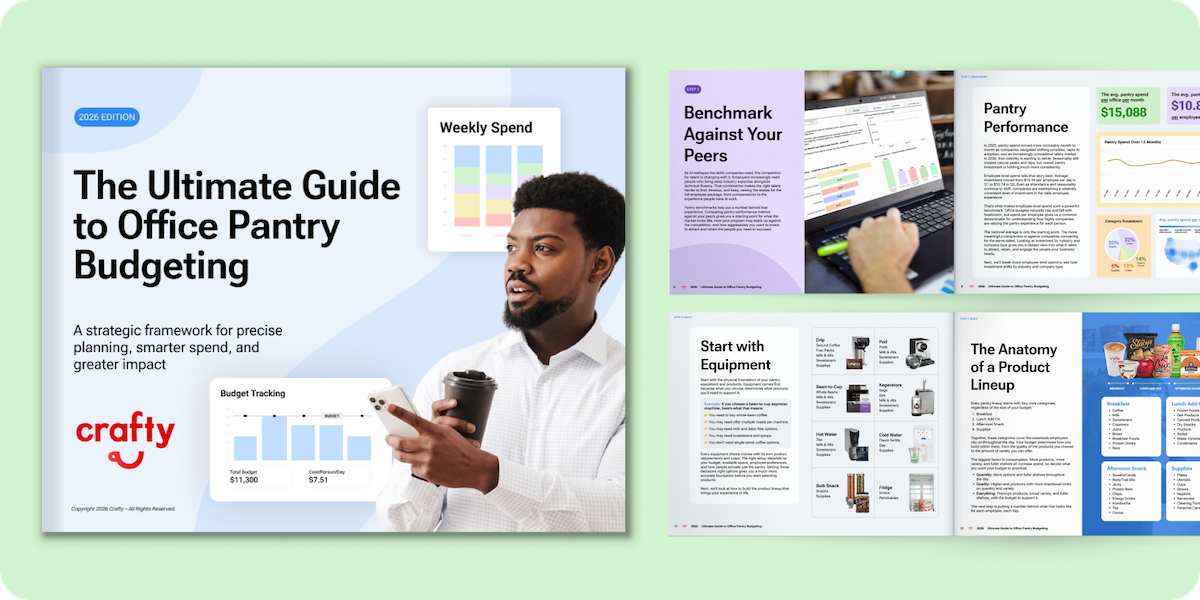
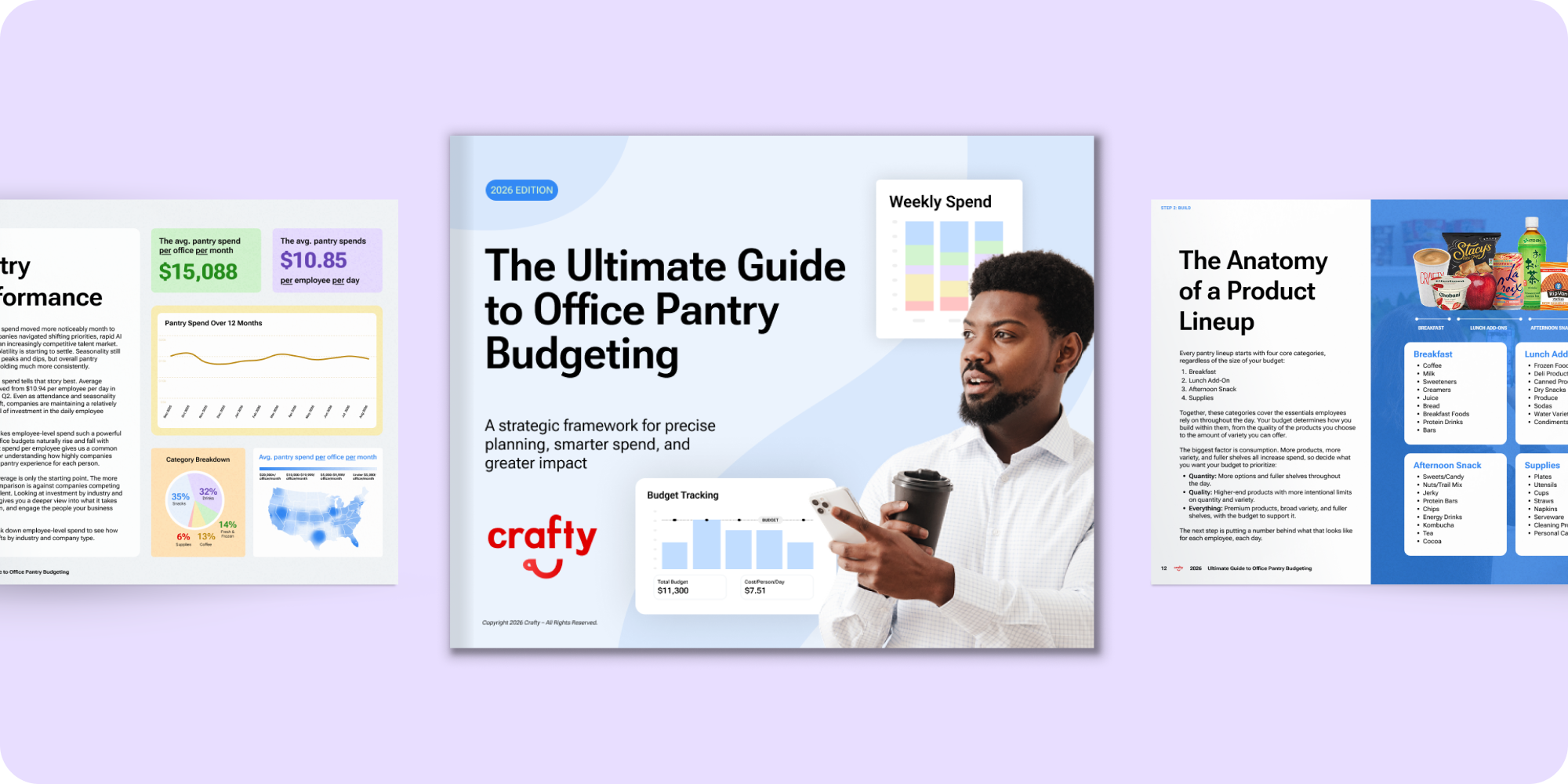
That’s exactly why we built the 2026 Ultimate Guide to Office Pantry Budgeting. It gives you the benchmarks, formulas, talk tracks, and optimization strategies to build a budget you can defend with confidence.
We’re pulling out four of the biggest lessons here to give you a taste.
1. Benchmark Pantry Spend Against the Talent You're Competing For
Everyone wants to know the magic number. Using the Pantry Intelligence Index, the average office is spending $10.85 per employee per day on their pantry program. But averages only get you so far.
Markets & Trading companies spend an average of $19.50 per employee per day, while Investment Firms average $14.71. Compare that with the $10.52 average across Technology or $7.92 across Professional Services, and it’s clear that the right office pantry benchmark depends on the environment you’re operating in and the talent you’re working to attract, engage, and retain.
That’s what makes benchmarking useful when finance comes calling. You’re not just showing them what you spend. You’re showing them where that investment sits in the market so you can show them what it takes to compete.
The lesson: Benchmark against the companies competing for the same talent, not just the national average. The 2026 Ultimate Guide to Office Pantry Budgeting gives you the industry and company-type benchmarks to find your number, plus the talk track to take it into your next budget conversation.
2. Build Your Budget From What Employees Actually Consume
The reality is you might not get to walk into a budget conversation and name your number. Finance will likely hand you one first.
That’s exactly why you need to know how to build an office pantry budget.
When you can work backward from what employees consume each day, put a cost behind that experience, and scale it across your headcount, you have something much stronger than “we need more money.” You can show exactly what the proposed budget buys and what changes when that number moves.
To finance right now, this is just a formula in a spreadsheet. It's your job to show them what that change looks like in reality and the domino effect it causes. A change in budget changes your cost per employee pantry tier, which changes the products, variety, and quality you can offer, which ultimately changes the experience employees get every day.
That’s where the negotiation gets more productive. Instead of debating one number, you can put the trade-offs on the table and show where you believe the investment will have the greatest impact. You can protect the parts of the program employees value most, identify where there’s room to flex, and make a stronger case for the dollars that matter.
The lesson: Know what the number represents. Your pantry budget determines the experience you can deliver and how well that experience supports the goals your company cares about. The 2026 Ultimate Guide to Office Pantry Budgeting gives you the formulas and planning framework to connect the dollars to the impact, make the tradeoffs clear, and advocate for the investment you need.
3. Keep Optimizing Pantry Spend
Your budget is a plan. Real life will have other ideas.
Consumption shifts. Employee preferences change. New products take off. Others slow down. Some categories end up demanding more of the budget than you expected. Even a perfectly built plan won’t play out exactly the way you modeled it.
The goal is to see those changes quickly enough to do something about them.
With the right real-time spend visibility, you can spot where there’s an opportunity to invest more impactfully, where you can pull back without hurting the experience, and where a product swap, category adjustment, merchandising change, or bulk alternative could make your dollars go further. That's also how you reduce office snack and coffee costs without making the pantry feel cheap.
That’s how your budget gets more precise over time. You’re not waiting for a monthly report to tell you what already happened. You’re reading the signals as they come in and acting while you still have plenty of options.
The lesson: Expect the plan to change, and make sure you have the visibility to change with it. The 2026 Ultimate Guide to Office Pantry Budgeting breaks down the signals to watch and the optimization levers you can pull to put every dollar where it will have the most impact.
4. Forecast Pantry Spend for What You Know Is Coming
The best budget conversations are the ones where finance never has to ask, “What happened here?” You already know, and better yet, you saw it coming.
Pantry spend will fluctuate throughout the year. Summer PTO can bring attendance down. Intern season can send it up. An all-hands can create a temporary spike. Even the weather changes what employees reach for. The good news is a lot of this should be a surprise if you have the right tools in place.
Your historical data gives you the pattern. Look at when spend rose or fell, which categories drove the change, and what was happening in the office at the time. Then layer in what you already know about the year ahead, from headcount and attendance plans to major events and seasonal shifts.
Now you can build those changes into your forecast before they happen. And when something does move differently than expected, you have the visibility to understand why, adjust quickly, and keep finance in the loop. That’s how you go from explaining spend after the fact to showing you have it under control.
The lesson: Use what you already know to stay ahead of what’s coming. The 2026 Ultimate Guide to Office Pantry Budgeting shows you how to turn historical spend, headcount, attendance, events, and seasonal patterns into a forecast that keeps you one step ahead.
Build a Budget That Performs
A stronger budget conversation starts long before finance puts a number in front of you.
- Benchmark your investment against the right companies.
- Know what your budget actually delivers.
- Keep optimizing as the data changes.
- Use what you already know to forecast what’s coming next.
Together, those four moves give you the facts to explain your spend, advocate for what will have the most impact, and show you’re managing every dollar with intention. The 2026 Ultimate Guide to Office Pantry Budgeting has the benchmarks, formulas, talk tracks, and optimization strategies to help you build your case before budget season gets real.
Go make finance proud.
Office Pantry Budget FAQs
How much should companies budget for an office pantry?
Across the Pantry Intelligence Index, the average office spends $10.85 per employee per day. But that national average is only a starting point. Investment varies significantly by industry and company type, so the most useful benchmark is what companies competing for similar talent are spending. Want to see how your investment compares? Explore the Pantry Intelligence Index.
How do you build an office pantry budget?
Start with the experience you want to deliver. Estimate what an employee will consume each day, calculate the cost per person, then scale that number across your headcount and working days. From there, break the budget into monthly and order-level targets your team can actually manage against. For the full formula and planning framework, download the 2026 Guide to Office Pantry Budgeting.
How can you make an office pantry budget more efficient?
Keep optimizing after the budget is set. Watch spend, consumption, and employee feedback to see where dollars could have more impact. Product swaps, category adjustments, bulk alternatives, merchandising changes, and removing slow movers can all help you get more precise with your investment.
What should you do if your office pantry is going over budget?
Start with the data before reaching for the red pen. Look for products eating up spend, slow movers, category surges, and high-volume single-serve products. Depending on what you find, you can swap products, adjust your inventory mix, move to bulk formats, rethink merchandising, or trim select varieties.
How do you justify an office pantry budget to finance?
Bring more than the total spend. Show how your investment compares with relevant benchmarks, what the budget delivers per employee, how you’re optimizing performance throughout the year, and what’s driving expected changes in spend. That gives finance the context behind the number and gives you stronger data to advocate for the investment your program needs.
Related Resource
Blog
4 Office Pantry Budget Lessons to Know Before Finance Comes Calling
October 2, 2026

Blog
Snacky Hour Episode 2 Recap: ITO EN Japanese Tea and Matcha
September 30, 2026
News
As the Fight for Talent Intensifies, New Data Shows Office Pantry Investment Holding Strong
September 30, 2026

Blog
7 Ways to Use Employee Voting to Build a Better Office Pantry
September 29, 2026

Blog
The Step-By-Step Guide to Calculating Your Office Pantry Budget
September 28, 2026

Blog
Tap an Expert: How to Build an Office Pantry Lineup Across Every Office
September 28, 2026

Blog
Equipment Guide: Pod Coffee Machines for the Office
September 23, 2026



Blog
Workplace Pantry Budgeting: A Practical Guide for Operations Leaders
September 17, 2026