min read
May 14, 2026
The Insider's Guide to Choosing a Workplace Pantry Provider [2026]
Understanding the operational models shaping today's workplace pantry programs, and what modern workplaces actually require.

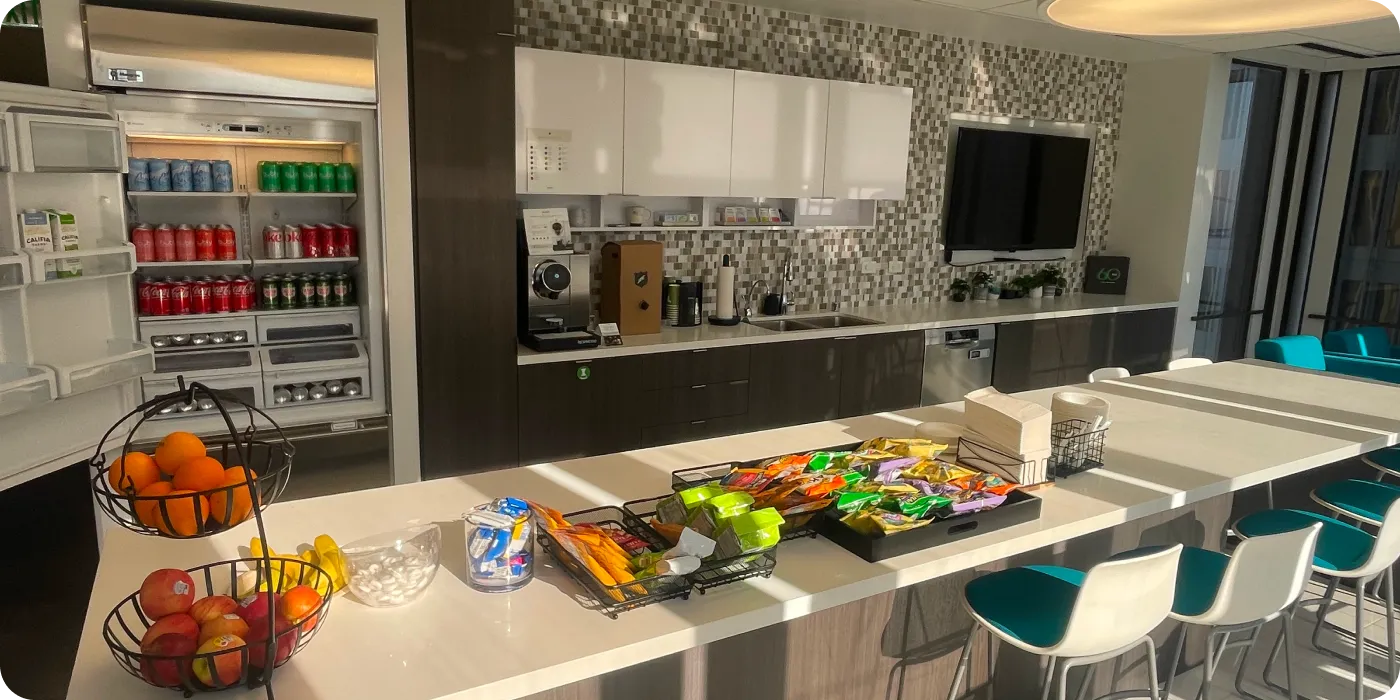
![The Insider's Guide to Choosing a Workplace Pantry Provider [2026]](https://cdn.prod.website-files.com/68ef636bea7f569ab00567aa/6a064429bc506592521c423b_The%20Insider%27s%20Guide%20to%20Choosing%20a%20Workplace%20Pantry%20Provider%20%5B2026%5D.webp)
For a long time, the workplace pantry was an add-on.
If companies wanted snacks, drinks, coffee, or breakroom supplies, they usually turned to whoever already handled food service in some capacity or placed ad hoc orders through a consumer marketplace. There wasn’t much strategy behind it because there weren’t many providers built specifically for the workplace pantry itself. Which meant companies were often choosing between providers whose real operational focus lived somewhere else entirely.
And for years, that was good enough...until it wasn't.
In 2026, pantry programs are part of the infrastructure shaping workplace experience, employee satisfaction, attendance strategies, and performance. At the same time, workplace teams are under increasing pressure to reduce waste, justify spend, manage multiple locations, and deliver more personalized office experiences without increasing operational complexity internally.
That shift is exposing what food service providers and product ordering platforms lack because the workplace pantry program is operationally unique. It requires continuous inventory management, behavioral forecasting, proactive onsite execution, consumption and reporting visibility, and systems designed specifically around how offices function day to day that support ongoing pantry optimizations
To get the best results from a pantry program, companies need data-backed systems and expert-driven services built specifically for workplace pantry operations. And that’s exactly what we’re going to break down.
Office-Pantry-First Providers
Office Pantry Providers: Crafty
Unlike broader food service providers, workplace-pantry-first companies were designed specifically around the operational realities of managing pantry programs at scale.
Crafty was built specifically to operate modern pantry programs, intentionally designed to help companies deliver and scale elevated workplace experiences while operating efficiently behind the scenes.
In today’s workplaces, attendance fluctuates week to week, employee preferences evolve constantly, and different offices consume and spend differently over time. Without systems designed specifically around workplace pantry operations, companies often end up overspending, dealing with inconsistent experiences, or relying heavily on internal workplace teams to manually manage the gaps.
Workplace pantry providers like Crafty use advanced technology to enable real-time inventory tracking and delivery verification, AI-powered optimization recommendations, filterable consumption data, quick-access support, and pantry spend tracking and forecasting to proactively manage pantries.
That tech-enabled operational model allows workplaces to:
- Reduce waste and overspending through smarter inventory planning and consumption tracking
- Scale pantry programs with centralized visibility into spend, trends, and operational performance
- Deliver more consistent and personalized employee experiences across offices
- Minimize the internal operational burden placed on workplace and office management teams
The companies getting the best results from their pantry programs are treating pantry programs with the same level of discipline as any other business function: guided by strategy and supported by systems, expertise, and infrastructure purpose-built for long-term performance, efficiency, and scalability.
Legacy Food Service Providers
Food Service Providers: Aramark, Sodexo (including inReach), and Compass Group (including Canteen)
Large legacy food service providers were built to run standardized, high-volume food operations across stadiums, cafeterias, universities, healthcare systems, vending operations, and yes, correctional facilities (YIKES). Their strength has always been scale, not quality, and definitely not agility.
Workplace pantry was never the core operational focus, but as pantry programs became more important to workplace experience, many of these providers simply layered pantry into existing food service infrastructure that was originally built for institutional food service and large-scale fulfillment.
That approach creates challenges in modern workplaces, where attendance fluctuates, preferences shift quickly, and teams are expected to do more with tighter budgets. Built around standardized operations rather than evolving employee preferences, these models often fail to adapt to changing tastes, workplace behaviors, and program needs. Workplace leaders and office managers are left managing service gaps, reconciling complicated invoices, and missing opportunities to optimize their programs.
The result is a pantry experience that often feels outdated, inflexible, and disconnected from today’s workplace expectations.
These rigid and outdated operational models result in workplaces experiencing:
- Limited visibility into pantry spend, inventory, and consumption
- Inconsistent and reactive vs proactive service across locations
- Increased time and operational overhead spent managing issues, requests, and replenishment adjustments
As workplace pantry becomes more connected to employee experience and operational efficiency, companies are increasingly realizing that traditional food service infrastructure was not designed for the flexibility, visibility, and ongoing optimization modern pantry programs require.
Local Food Service Vendors
Local pantry vendors are often built around personalized relationships and regional service. Their strength is usually responsiveness, familiarity with the local market, and a more hands-on experience (which is why Crafty partners with many of them — shout out to our amazing partners!).
For individual offices or regional programs, that localized approach can work really well. The challenge starts when workplace leaders try to scale that model nationally and suddenly find themselves managing a growing network of disconnected vendors across offices and regions.
Managing multiple local vendors across offices means juggling different ordering processes, invoices, support contacts, reporting styles, and service expectations all at once. Over time, workplace leaders end up spending more energy managing the vendors and filling operational gaps than improving the workplace experience itself.
That fragmented operational model can result in workplaces experiencing:
- No consistency in pantry experiences, service levels, and reporting across offices
- No centralized visibility into total spend, utilization, inventory, and vendor performance
- Increased internal time and operational overhead spent coordinating vendors, resolving inconsistencies, and managing day-to-day issues across offices
As workplace programs scale, companies increasingly need infrastructure that combines local flexibility with centralized visibility, operational consistency, and scalable program management. That’s where Crafty comes in. By combining localized expertise with centralized systems and operational oversight, workplace leaders no longer need to choose between local experience and scalable operations.
Consumer Marketplaces
Online Marketplaces: Amazon, Costco, Instacart, DoorDash, etc.
Consumer marketplaces were built to make ordering fast and convenient. Their strength is simple and fast delivery, and for smaller offices or early-stage pantry programs, that convenience can feel like enough.
The challenge is that consumer marketplaces stop at delivery. There’s no onsite service, no inventory management, no equipment support, and no centralized operational oversight, helping workplace teams manage the program over time. If the coffee machine breaks, products are stocked incorrectly, inventory disappears too quickly, or one office is overspending while another is underutilizing its budget, workplace teams are usually left figuring it out themselves.
As companies scale across locations, that operational gap becomes even more difficult to manage. Different offices often place orders independently, use different systems, manage separate budgets, and operate without shared visibility into pantry performance across the organization.
That disconnected operational model can result in workplaces experiencing:
- Varied and inconsistent pantry experiences and standards across offices
- No visibility into inventory usage, spending trends, budget management, and operational inefficiencies
- Significant internal time spent managing deliveries, equipment issues, restocking, and pantry logistics
Sure, consumer marketplaces make ordering easier, and they may even have a lower price on LaCroix, but the hidden cost is astronomical. Workplace teams often end up absorbing the operational burden themselves through lost time, inconsistent experiences, unmanaged inventory, equipment issues, and a complete lack of centralized oversight.
Catering Companies
Catering-First Providers: Fooda, ezCater, ZeroCater, HUNGRY, etc.
Catering providers were built around event-based meal fulfillment. Their strength is coordinating scheduled meals, group ordering, and office catering logistics at scale. And to be fair, many of them do that really well (that's why we partner with ezCater after all).
The challenge is that pantry and catering are fundamentally different operational models and fulfill fundamentally different workplace needs. One is transactional. The other is operational.
- Catering is about fulfilling a scheduled, one-time order.
- Pantry is about continuously managing inventory, utilization, replenishment, and onsite experience over time.
As workplace pantry programs became more important, some catering providers are attempting to expand into the category by layering snack delivery onto systems originally designed for meal coordination and delivery workflows. That mismatch can create challenges for workplace teams because pantry requires significantly more than placing and delivering on recurring orders. It requires constant oversight, behavioral forecasting, proactive replenishment, budget management, and ongoing program optimization, capabilities that catering infrastructure was not designed to support.
That operational disconnect can result in workplaces experiencing:
- Inconsistent and chaotic inventory replenishment across offices
- Limited visibility and no tooling for pantry forecasting, optimization, and consumption tracking
- Increased operational gaps caused by a lack of dedicated pantry expertise and ongoing program management
Combining catering and pantry under one provider may reduce the number of vendors, but it also creates major operational gaps. Pantry programs require continuous oversight, optimization, and inventory management that most catering systems simply were not built to support, and it will show.
New Startups That Try to Do It All
MicroMarket Providers: Garten (Now Owned by Catering Provider Hungry)
The rise of workplace experience has created a new wave of startups trying to do it all, including catering, micromarkets, vending, and any other office service you might want to buy.
On the surface, fewer vendors and broader offerings sound appealing. But the tradeoff is that expanding across multiple operational models at once can make it difficult to deliver the consistency, specialization, and operational maturity your pantry programs require.
When companies try to scale all of those models simultaneously, workplace teams can end up experiencing:
- Inconsistent service and operational execution across locations
- Fragmented systems and unclear ownership between services
- Limited visibility into pantry-specific performance and optimization opportunities
As workplace teams are being asked to deliver better employee experiences with tighter budgets and leaner resources, companies can’t afford to hand over pantry spend to providers without the operational expertise, systems, and specialization needed to manage it effectively.
How Should Companies Choose a Pantry Provider?
The biggest mistake companies make when choosing a pantry provider is evaluating pantry like a purchasing decision instead of an operational one.
By now, it should be clear that not all food service providers offer the same services or operate in the same way. Some were built for institutional food service. Others for catering logistics, ecommerce convenience, or other broader food offerings. And those operational foundations directly impact how pantry programs perform over time.
The strongest pantry programs are actively managed through systems designed specifically for workplace pantry operations, including inventory forecasting, onsite support, centralized reporting, and ongoing optimization.
When evaluating providers, workplace leaders should ask themselves:
- Was this provider built specifically for workplace pantry operations?
- What operational responsibilities still fall onto our internal team?
- How does the provider help optimize spend, reduce waste, and improve consistency over time?
Does the provider continuously adapt to changing employee preferences, workplace behaviors, and office consumption patterns? Companies are realizing pantry programs are too operationally important to manage through reactive systems or providers treating pantry like a secondary offering or side grab.
Conclusion
For years, companies accepted the limitations of pantry programs because there were few alternatives. Pantry was too often treated like another food order, another vendor relationship, or another operational task workplace teams simply had to manage manually.
Those days are long gone.
Today, workplace leaders have a much clearer understanding of what successful pantry programs actually require: operational expertise, visibility, consistency, and systems purpose-built for how modern workplaces function.
As pantry programs become more connected to employee experience, workplace strategy, and operational efficiency, companies are beginning to recognize that pantry is not just a purchasing decision; it’s an operational one.
And as expectations around employee experience, operational efficiency, and data visibility continue to rise, providers built specifically for workplace pantry operations will increasingly outperform providers treating pantry as a secondary service.
Related Resource
Blog
Equipment Guide: Pod Coffee Machines for the Office
September 23, 2026

Blog
Best Halal Office Snacks for Your Pantry
September 16, 2026

Blog
Snacky Hour Episode 1 Recap: Mezcla, LatinX-Owned Protein Bars
September 15, 2026

Blog
Data Bites: Which Companies Are Spend Most on Office Pantry Programs in Q2 2026?
September 15, 2026

Blog
Best California Snack and Coffee Brands to Stock in Your Office Pantry
September 10, 2026
Blog
Office Equipment Guide: Drip Coffee Machines for the Office
September 10, 2026

Blog
Celebrate Halloween at Work: Breakroom Snacks, Activities, Decor, & More
September 9, 2026
Blog
October Holidays for Work: Breakroom Snack Celebrations
September 9, 2026