min read
September 17, 2026
Workplace Pantry Budgeting: A Practical Guide for Operations Leaders
How workplace leaders can budget smarter for office pantry costs, headcount growth, and return-to-office demand.


Key Takeaways
- Build your pantry budget from the bottom up: start with per-employee consumption, then layer in headcount growth by market and your office attendance plan.
- Budget for how often people are actually in the office, not just how many people you employ, since each added in-office day raises weekly pantry demand.
- Present pantry spend to leadership as an investment in return-to-office success, engagement, and employer brand, backed by data rather than a single target number.
Why Workplace Pantry Budgeting Matters for Operations Leaders
Workplace pantry budgeting plays a critical role in how modern offices operate day to day, influencing everything from workplace costs to employee experience and return-to-office success.
For operations and workplace leaders, pantry budgeting sits at the intersection of cost management, workplace experience strategy, and office attendance planning. Decisions around what to stock, how much to spend, and how to allocate budget across locations quickly show up in employee engagement, in-office behavior, and overall workplace satisfaction.
From a COO’s perspective, managing workplace pantry costs requires balancing inflation, headcount changes, and evolving return-to-office expectations, while still delivering a consistent, high-quality employee experience. Even small shifts in attendance or consumption can significantly impact your office pantry budget.
When approached with the right data and strategy, workplace pantry budgeting becomes a powerful lever, one that helps organizations control costs, support employee engagement, and align their workplace experience with broader business goals.
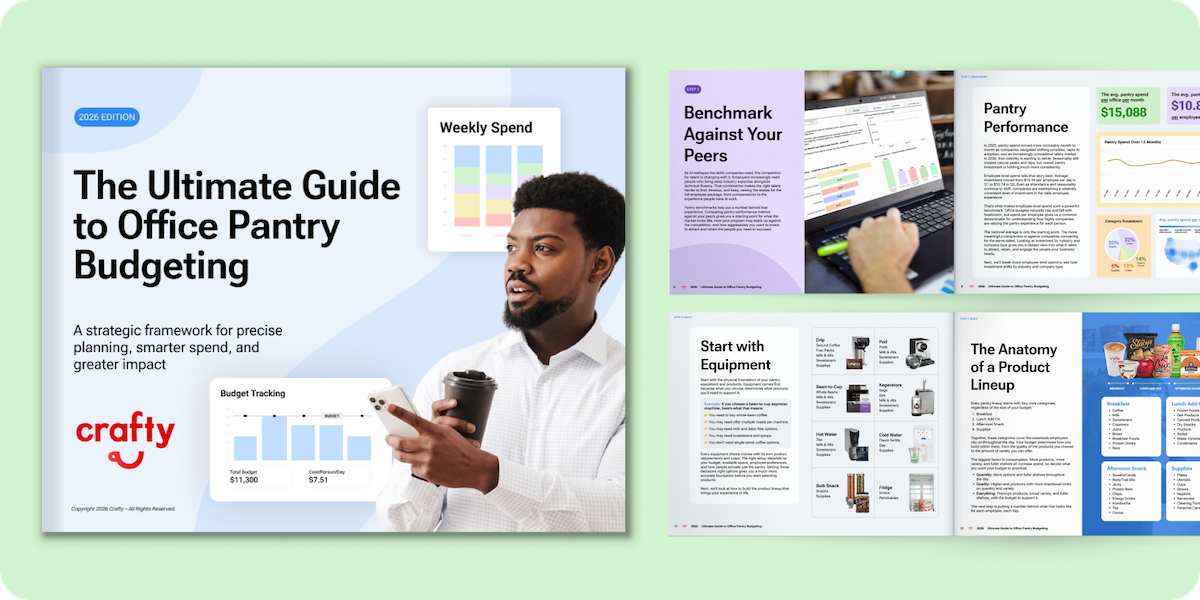
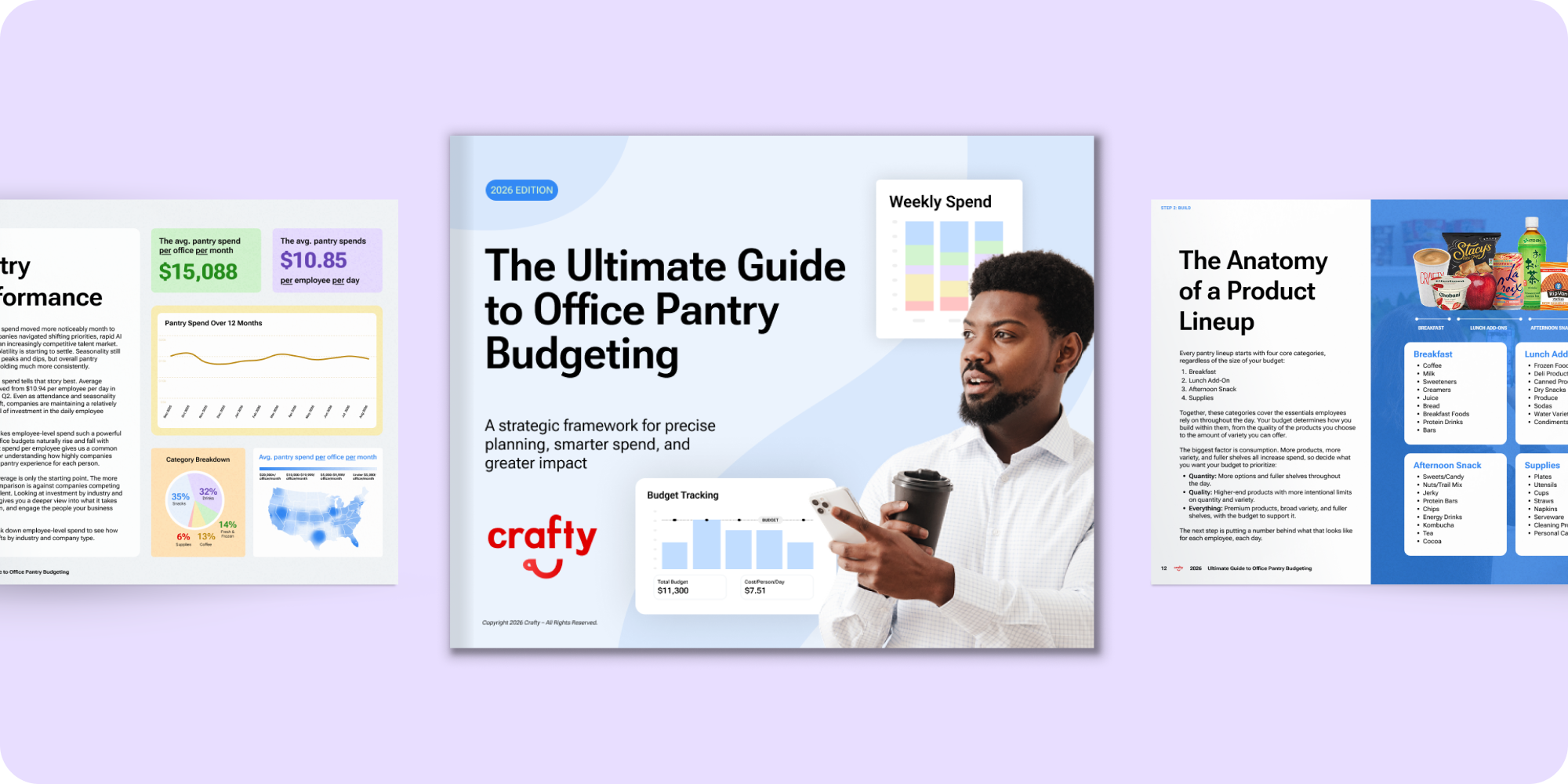
Heading into your next planning cycle? Download Crafty's Office Pantry Budget Report for the benchmarks you need to build and defend your pantry budget.
1. Understand Food Inflation and Pantry Trends
Over the past year, workplace pantry and food service costs have continued to rise. According to the US Bureau of Labor Statistics, “Food Away From Home” category of the Consumer Price Index (CPI), the industry saw a 3.9% increase in product costs.
- 2023: +5.2%
- 2022: +7.7%
- 2021: +4.5%
While inflation has moderated, food costs remain elevated compared to pre-pandemic levels, meaning a flat pantry budget delivers less value than it used to.
However, focusing only on inflation misses a larger opportunity: using your workplace pantry program as a strategic advantage, not just a cost center.
2. Budget in Alignment with Your Headcount Growth
The biggest driver of pantry spend is your people.
Before you finalize next year’s budget, align your assumptions with your company’s headcount plans by market. If your New York office is growing by 15%, but your Chicago headcount is flat, your budget should reflect that. Even modest headcount changes can materially shift your total pantry spend.
Pro tip: Start with average consumption per employee per week, then layer in your headcount projections to build a bottom-up forecast.
3. Factor in Return-to-Office Dynamics
If your leadership team is increasing in-office days, say, moving from three to four days a week, that has a massive impact on pantry demand. Each incremental in-office day can translate into a 20–25% increase in weekly pantry consumption.
Make sure your pantry budget reflects your workplace attendance strategy, not just your headcount. Misalignment here often leads to over- or under-budgeting by thousands of dollars per month.
4. Define Your Desired Experience Level
Every company has a different philosophy on its workplace experience. At Crafty, we help clients think in terms of three clear tiers, each one designed to match your culture, goals, and financial guardrails:
- Stock It – Full Shelves are the Priority
Your budget is flexible, and you prioritize the employee experience over everything else. If consumption outpaces the budget, you want to keep stocking the shelves. - Optimize It – Maximizing Budget is the Priority
Your budget needs to be used, or you lose it. You want to ensure every dollar is put to use to craft the ultimate experience. That said, you are willing to make concessions to ensure spending never goes over budget. - Save It – Saving Money is the Priority
You want to look for opportunities to refine your program and use smart inventory management to save money while still providing a great experience.
The key question for leadership is: “Do we want our workplace pantry to meet expectations, or help differentiate us in the competition for top talent?”
Benchmarking your pantry experience against peer companies in your market helps ensure your investment aligns with your employer brand.
5. Have the Right Conversations with Leadership
Your workplace pantry is more than a budget line item; it’s a visible reflection of your culture and operational priorities.
When entering pantry budgeting discussions, don’t focus on cost alone. Frame the conversation around impact:
- How the pantry supports return-to-office attendance
- How it contributes to employee wellbeing and engagement
- How it reinforces your employer brand and workplace experience
The strongest operations leaders come prepared with data, context, and a clear strategy, not just a target number.
6. Partner with Experts Who Can Help
At Crafty, we help companies plan and manage workplace pantry programs that balance cost efficiency with experience excellence.
From inflation modeling and headcount forecasting to peer benchmarking and assortment strategy, our team helps operations and workplace leaders approach pantry budgeting with confidence.
Bottom line: your workplace pantry budget is an investment in your people, your culture, and your ability to create an office that employees want to come into. Walk into budget conversations with data. Get the Office Pantry Budget Report to see how your pantry investment compares.
FAQ
What has the biggest impact on a workplace pantry budget?
Headcount is the largest driver, followed by in-office attendance, food cost inflation, and the experience level your company wants to deliver. A strong budget accounts for all four instead of carrying last year's number forward.
How does return-to-office policy affect office pantry costs?
More in-office days mean more consumption per employee, so a shift from three to four days a week can raise pantry demand even with flat headcount. Tie your budget assumptions to your attendance strategy so you don't under-budget mid-year.
How do I justify pantry spend to executives?
Frame the pantry around business impact: how it supports office attendance, employee wellbeing and engagement, and your employer brand. Bring peer benchmarks from Crafty's Pantry Intelligence Index and consumption data so the conversation centers on value delivered rather than cost alone.
How much should I budget for an office pantry per employee?
It depends on your headcount, attendance, and experience tier. For a step-by-step method, use our guide to calculating your office pantry budget.
Related Resource
Blog
Equipment Guide: Hot Water Machines for the Office
October 2, 2026
Blog
4 Office Pantry Budget Lessons to Know Before Finance Comes Calling
October 2, 2026

Blog
Snacky Hour Episode 2 Recap: ITO EN Japanese Tea and Matcha
September 30, 2026
News
As the Fight for Talent Intensifies, New Data Shows Office Pantry Investment Holding Strong
September 30, 2026
Blog
7 Ways to Use Employee Voting to Build a Better Office Pantry
September 29, 2026
Blog
The Step-By-Step Guide to Calculating Your Office Pantry Budget
September 28, 2026

Blog
Tap an Expert: How to Build an Office Pantry Lineup Across Every Office
September 28, 2026
Blog
Equipment Guide: Pod Coffee Machines for the Office
September 23, 2026